https://www.pv-magazine.fr/2025/11/24/e ... electrons/En Ouzbékistan, la centrale photovoltaïque Sarimay Solar livre ses premiers électrons
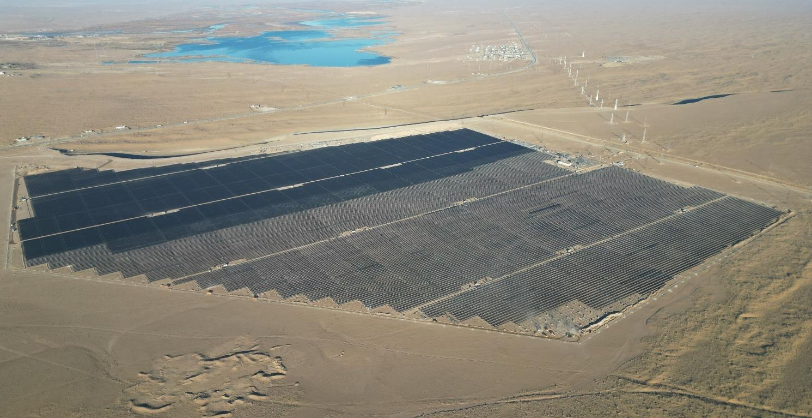
Voltalia annonce le démarrage de la production de sa centrale solaire de 126 mégawatts située à Sarimay, dans la région de Khorezm en Ouzbékistan.
novembre 24, 2025 Francois Puthod
Image : Voltalia
Attribuée à Voltalia via un appel d’offres public lancé en décembre 2022 et soutenu par un contrat d’achat d’électricité (PPA) de 25 ans, la construction d’une centrale solaire de 126 mégawatts, située à Sarimay, dans la région de Khorezm en Ouzbékistan, est arrivée à son terme.
Financé par la Banque Européenne pour la Reconstruction et le Développement (BERD) avec le soutien du Fonds Européen pour le Développement Durable Plus, ce projet de 180 hectares intègre plus de 180 000 panneaux solaires bifaciaux, plus de 350 onduleurs et une ligne de transmission de trois kilomètres. Une fois pleinement opérationnelle, la l’installation produira environ 252 gigawattheures par an – de quoi alimenter 60 000 habitants – et permettra d’éviter plus de 140 000 tonnes de CO₂ chaque année.
Voltalia a piloté le projet depuis la phase de développement jusqu’à la supervision de l’ingénierie, de l’approvisionnement et de la construction (EPC) ainsi que la maintenance prévue dès la mise en service complète de la centrale.
À noter que le producteur développe un deuxième projet majeur en Ouzbékistan : Artemisya, un complexe hybride de 500 hectares, dont la première phase prévoit 100 mégawatts d’énergie éolienne et 100 mégawatts / 200 mégawattheures de stockage. Le début de la construction est prévu en 2026, avec une mise en service fin 2027. La capacité de production d’Artemisya est estimée à 383 gigawattheures par an.
Ouzbékistan
Modérateurs : Rod, Modérateurs
-
energy_isere

- Modérateur

- Messages : 108100
- Inscription : 24 avr. 2005, 21:26
- Localisation : Les JO de 68, c'était la
- Contact :
Re: Ouzbékistan
suite de ce post du 25 mai 2024 http://www.oleocene.org/phpBB3/viewtopi ... 0#p2391610
-
energy_isere
- Modérateur
- Messages : 108100
- Inscription : 24 avr. 2005, 21:26
- Localisation : Les JO de 68, c'était la
- Contact :
Re: Ouzbékistan
suite de ce post du 11 oct 2025 : http://www.oleocene.org/phpBB3/viewtopi ... 1#p2417521
https://www.world-nuclear-news.org/arti ... hin-monthsFirst concrete for Uzbekistan SMR 'well before December'
Wednesday, 28 January 2026
Uzbekistan President Shavkat Mirziyoyev and Rosatom Director General Alexei Likhachev have discussed progress on the project to build a nuclear power plant featuring both large and small reactors.
According to the president's news service the two also talked about "expanding cooperation in the peaceful use of nuclear energy", in areas such as agriculture and medicine.
First concrete for the first small modular reactor had been expected to be poured in the spring, but a draft government document published last week mentioned December 2026.
That led to the Uzatom Agency publishing a clarification on Monday saying: "We would like to emphasise that the previously announced targets remain in effect, and there is no discussion of any postponement. The date indicated in the draft reflects a conservative scenario, which envisages the completion of all numerous mandatory preparatory and licensing stages by this date."
Following the talks on Tuesday, Likhachev said: "We are moving forward at a rapid pace and fully on schedule. Work on site is proceeding actively ... this year's main goal is to begin pouring concrete for the foundation slab of the nuclear island buildings. Given the importance of meeting deadlines, we aim to begin concrete preparation work this spring."
In a subsequent interview with Russia’s Rossiya-24 television channel, as reported by the official Tass news agency, he said: "I think we will pour the first concrete … much earlier than December. Our speed will depend on the customer … this is a regulated event implying receipt of certain licences, permits, qualifications, including for local manufacturers. Nevertheless, our plans are to make it much earlier than December."
.........................
Excavation work began in October for the pit for the first of the SMRs at the site in the Jizzakh region. About 1.5 million cubic metres of soil will be excavated during the digging of a pit 13 metres deep for the RITM-200N, with engineering surveys and design and preparatory works also under way.
-
energy_isere
- Modérateur
- Messages : 108100
- Inscription : 24 avr. 2005, 21:26
- Localisation : Les JO de 68, c'était la
- Contact :
Re: Ouzbékistan
https://www.world-nuclear-news.org/arti ... n-progressUzbekistan and Russia mark SMR construction progress
Tuesday, 24 March 2026
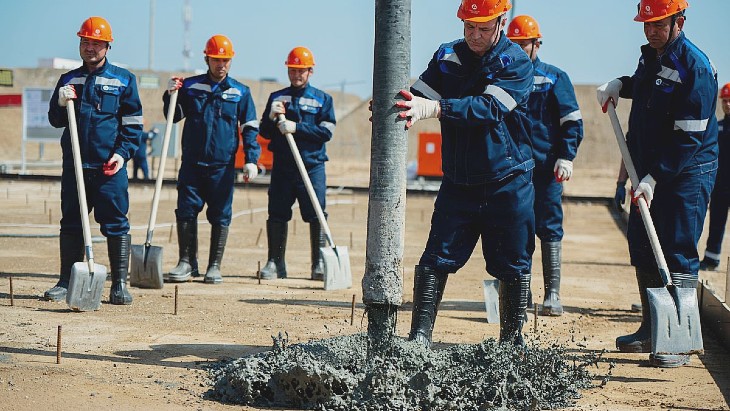
Russia and Uzbekistan have signed a roadmap for nuclear cooperation, as initial concrete was poured as part of preparations for the construction of the first small modular reactor at Uzbekistan’s first nuclear power plant.
(Image: Rosatom)
The roadmap, signed by Rosatom Director General Alexey Likhachev and Uzatom Director Azim Akhmedkhadzhaev, "covers all key areas of cooperation on the nuclear power plant construction project, including personnel training, public awareness of modern nuclear technologies, and the creation of a future 'nuclear city' at the plant".
A supplemental agreement to the contract for the new nuclear power plant covers the decision to change its contents to two gigawatt-scale VVER-1000 units and two 55 MWe RITM-200N small modular reactors (SMRs). The original plan had been for the plant to feature six of the SMRs - the new design will mean a capacity of more than 2,100 MWe, compared with the previous 330 MWe.
The two countries' presidents spoke on the phone on Tuesday, noting the signing of the roadmap and the progress being made for the first SMR unit at the site, in the Jizzakh region.
Rosatom said that, following the receipt of the necessary permissions to use the site for the two SMRs, concrete work had begun at the site, saying that "approximately 900 cubic metres will be poured during the concrete foundation work for the reactor building, due for completion in April". It said that this foundation will then be levelled and waterproofed before "the pouring of the first concrete for the reactor building's foundation slab".
......................
-
energy_isere
- Modérateur
- Messages : 108100
- Inscription : 24 avr. 2005, 21:26
- Localisation : Les JO de 68, c'était la
- Contact :
Re: Ouzbékistan
https://www.world-nuclear-news.org/arti ... productionUzbek uranium mine enters commercial production
Thursday, 23 April 2026
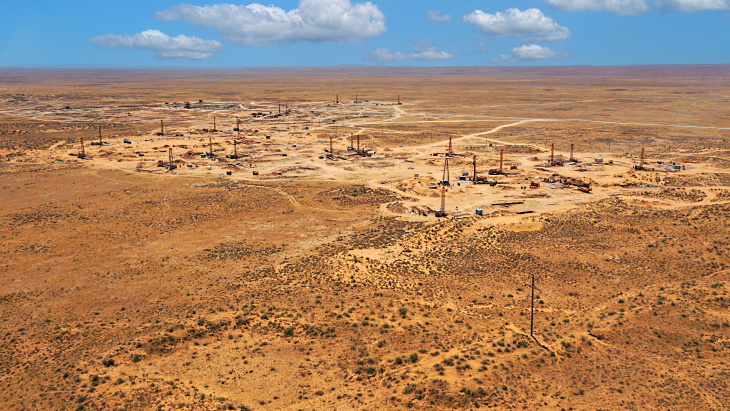
Navoiyuran has announced the start of commercial in-situ uranium recovery at the Qizilkok deposit, located in the Navoi region of Uzbekistan.
(Image: Navoiyuran)
"Pilot industrial operations at the deposit began in December 2024, and over two years of active work, the Company has reached the stage of commercial production," said Djamal Sabakhonovich Fayzullayev, General Director of Navoiyuran. "The start of ore mining at the deposit marks another step in the implementation of the company's strategy, focused on increasing uranium production and strengthening its mineral resource base, in line with Uzbekistan's state programme to expand uranium mining and processing volumes through 2030.
"In 2025, Navoiyuran's production reached 7,000 tonnes of natural uranium. The Qizilkok deposit, with a projected mine life of 15 years and an annual production capacity of 1,200 tonnes of uranium, will play a key role both in supporting future production growth and in contributing to regional economic development."
The Qizilkok prospective area - situated in the eastern part of the Central Kyzylkum Desert - comprises four licence blocks: Amantau (in the northwestern part), Myutenbay (in the northeastern part), Qizilkok (in the southeastern part), and Yuzhny (in the southern part). Under the project, all of these licence blocks are integrated into a single prospective area, Qizilkok.
The Qizilkok deposit is being developed using a low-reagent in-situ recovery oxygen technology actively advanced by Navoiyuran, which it says increases uranium recovery while reducing production costs by 2-3 times.
In-situ recovery - or ISR - is a method of mining uranium by dissolving and recovering it via wells. It is also known as in-situ leaching. Ground water fortified with a complexing agent, and often with an oxidant (such as gaseous oxygen), is introduced into the orebody to dissolve the uranium from the sandstone host. The uranium-bearing solution is pumped to the surface before the uranium is recovered and processed into yellowcake.
Navoiyuran describes Qizilkok - with mineral resources of 10,900 tU and ore reserves of 9,400 tU - as the third-largest deposit in its portfolio, following the Sugrali (20,800 tU of reserves) and Uchkuduk (14,800 tU of reserves) deposits. It has a project mine life of 15 years, with further potential for expansion to the north.
Uzbekistan's estimated uranium output in 2024 was 4,000 tU, according to information from World Nuclear Association, making it the fifth largest uranium producer in the world behind Kazakhstan, Canada, Namibia and Australia. Navoiyuran says it is currently the sixth-largest uranium producer globally, operating 43 uranium deposits with a mineral resource base of 151,100 tU, including 96,600 tonnes of JORC-compliant ore reserves.
-
energy_isere
- Modérateur
- Messages : 108100
- Inscription : 24 avr. 2005, 21:26
- Localisation : Les JO de 68, c'était la
- Contact :
Re: Ouzbékistan
https://www.bfmtv.com/economie/internat ... 10450.htmlElle est au coeur de l'Asie centrale et assise sur un beau stock d'uranium, d'or et de minerais stratégiques: comment Washington et Pékin partent à l'assaut de l'Ouzbékistan
Mathieu Jolivet Publié le 21/10/2026 BFM Business
Les États-Unis et la Chine convoitent tous deux les ressources stratégiques de l'Ouzbékistan et veulent asseoir leur influence sur cette région d'Asie centrale. Mais Pékin a pris une longueur d'avance.
À 48 heures d’intervalle, le Premier ministre chinois Li Qiang puis le secrétaire d’État américain Marco Rubio se sont succédé en Ouzbékistan. Derrière ce chassé-croisé diplomatique se joue une bataille d’influence entre les deux premières puissances économiques mondiales. Riche en minerais stratégiques et situé au carrefour des grandes routes commerciales de l’Eurasie, ce pays d’Asie centrale est hyper convoité.
Les États-Unis cherchent à rattraper leur retard alors que Pékin a pris une longueur d’avance. Marco Rubio est arrivé à Samarcande avec une délégation impressionnante : plus de 200 dirigeants d'entreprises américaines. Boeing, Citi, Blackrock, Franklin Templeton… Résultat : 54 accords et projets annoncés, pour près de 12 milliards de dollars, dans les secteurs des mines, de l'énergie, de la finance ou encore des transports.
Seulement voilà, deux jours plus tôt, c'est le Premier ministre chinois Li Qiang qui était reçu à Tachkent par le président ouzbek, Chavkat Mirzioïev. Une véritable bataille d'influence entre Washington et Pékin est à l'oeuvre.
Une position géographique exceptionnelle
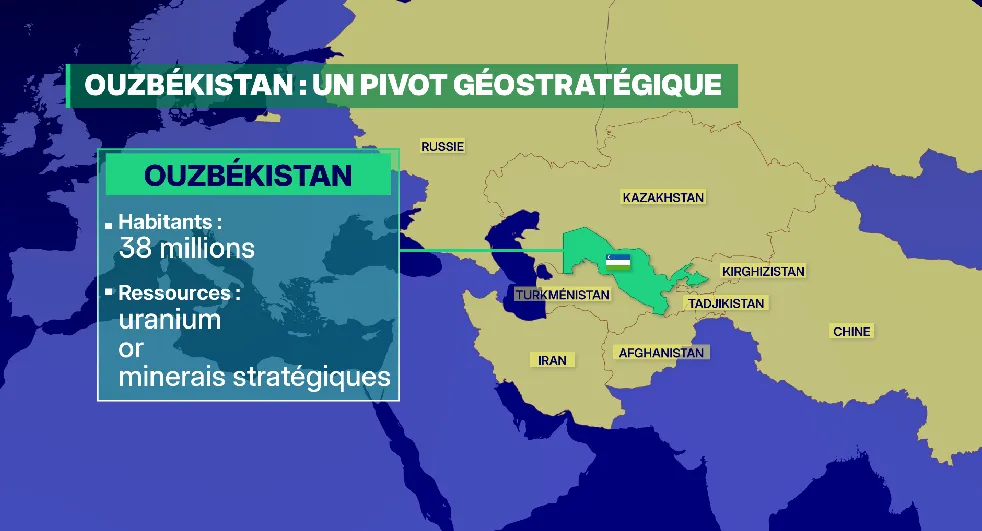
Il suffit de regarder une carte pour saisir le caractère géostratégique de l’Ouzbekisran: au cœur de l'Asie centrale, entre la Russie, la Chine, l'Iran et l'Afghanistan, sur les grands corridors qui relient l'Asie à l'Europe.
L'Ouzbékistan est le seul pays à partager une frontière avec les quatre autres pays d'Asie centrale : le Kazakhstan, le Kirghizistan, le Tadjikistan et le Turkménistan.
Elle compte près de 38 millions d'habitants, la population la plus importante de la région. Et un sous-sol riche en uranium, en or et en minerais stratégiques. Autrement dit, une pièce maîtresse.
Comment les Américains ont perdu pied
Les Américains veulent y retrouver une influence qu'ils ont perdue. Et pour comprendre pourquoi, il faut remonter aux années 90. En 1991, l'Union soviétique s'effondre. Pour la première fois dans l'histoire, les États-Unis deviennent la seule puissance véritablement globale. C'est-à-dire que sur tous les plans, économique, militaire et culturel, ils sont les maîtres du monde.
À l’époque, l’un des plus grands stratèges américains Zbigniew Brzezinski (un conseiller de Jimmy Carter), va émettre une doctrine autour de l’Eurasie. Sa thèse, c'est que pour conserver leur suprématie mondiale, les États-Unis ne doivent laisser aucune autre puissance contrôler l'espace eurasiatique, qui s'étend, pour faire simple, de Lisbonne à Shanghai.
Et au milieu de cet espace se trouvent l'Ouzbékistan et les pays d'Asie centrale. La politique étrangère des États-Unis va donc notamment consister à empêcher la Russie ou la Chine de dominer cette région stratégique.
Les Américains investissent donc la région. Après le 11-Septembre, ils installent même une base militaire en Ouzbékistan, pour mener leur guerre en Afghanistan. Mais Washington veut aussi exporter son modèle démocratique. Et ça, ça ne plaît pas aux régimes locaux n'aiment pas.
En mai 2005, l'armée ouzbèke tire sur la foule à Andijan. Washington critique la répression. Le régime répond en expulsant les soldats américains. Résultat : l'Ouzbékistan se rapproche de Moscou et de Pékin, qui en profitent pour renforcer leur influence.
Trump change de méthode mais la Chine a une longueur d'avance
Aujourd'hui, Donald Trump opte pour un changement de méthode. Fini les leçons de démocratie, fini les droits de l'homme comme condition préalable aux affaires. La diplomatie américaine devient transactionnelle.
D'ailleurs, l'Ouzbékistan a été l'un des premiers pays à rejoindre le Conseil de la paix de Donald Trump. Un organe présidé à vie par Trump lui-même, et où un siège permanent nécessite une contribution d'un milliard de dollars.
L'objectif de Washington est de sécuriser un accès aux minerais critiques, dont la tech - qui tire la croissance américaine - a tant besoin. Une stratégie business, mais aussi géopolitique.
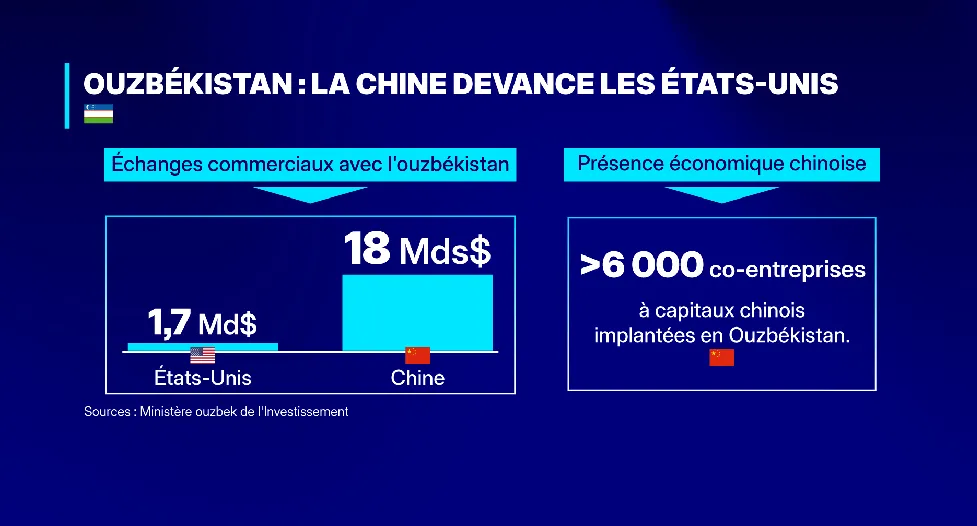
Seulement voilà, les Chinois ont pris une sacrée longueur d'avance. Les États-Unis commercent beaucoup moins avec l'Ouzbékistan que la Chine. Les échanges commerciaux ouzbeks avec la Chine sont 10 fois supérieurs à ceux avec les États-Unis.
Plus de 6.000 entreprises à capitaux chinois sont installées dans le pays, contre quelques centaines seulement côté américain. Voilà le retard que Trump tente de combler.
Depuis l'invasion de l'Ukraine, les anciennes républiques soviétiques cherchent à diversifier leurs partenaires, pour ne plus dépendre ni de Moscou, ni de Pékin et Washington veut s'engouffrer dans la brèche.
Une situation qui rappelle le Caucase. Donald Trump a mis son nom sur un corridor stratégique entre l'Arménie et l'Azerbaïdjan : la "Trump Route for International Peace and Prosperity". Là encore, il s'agit de peser sur les routes commerciales de l'Eurasie. Pour cela, le président américain n'hésite pas à sortir le carnet de chèques et à jouer sa diplomatie au bazooka. Mais il arrive avec vingt ans de retard…
-
energy_isere
- Modérateur
- Messages : 108100
- Inscription : 24 avr. 2005, 21:26
- Localisation : Les JO de 68, c'était la
- Contact :
Re: Ouzbékistan
https://www.world-nuclear-news.org/arti ... nstructionRosatom eyes 2027 for Uzbek large reactor construction
Friday, 23 October 2026
Rosatom plans to launch construction of the large-scale nuclear units at the planned power plant in Uzbekistan in 2027, CEO Alexey Likhachev has said during a visit to the construction site.
Two small modular reactors (SMRs) are already under construction at the site in the Jizzakh region, where the first concrete for the foundation slab was poured in May. The slab is scheduled to be completed by the end of the year.
"This small-scale facility, which will be located here, is a unique, state-of-the-art small nuclear power plant project on the planet, and the only one in the world currently being implemented using an export model," noted Alexey Likhachev.
Two 1,000 MW units are also planned to be located near to the smaller units. Rosatom said engineering surveys and design refinements are currently under way at the site, with work expected to enter full-scale operation next year.
"More than 1,000 people are already working here, and the workforce will double at least in the coming months," Likhachev said. Rosatom has said it intends to outsource a significant portion of the general construction work to Uzbek companies.
Long-lead equipment is being manufactured in parallel, Rosatom said: a reactor vessel for one SMR has already been manufactured. Recruitment of operating personnel for the first SMR unit is planned to begin by the end of 2027, and a "nuclear city" designed to accommodate 33,000 residents in its first phase is to be built near the plant.
Training of qualified nuclear energy specialists and cooperation on the residential development - to feature energy-efficient housing, modern educational, healthcare and sports facilities, along with other amenities - were also discussed during a meeting between Uzbekistan President President Shavkat Mirziyoyev and Likhachev.