https://www.mining.com/web/anfield-seek ... dium-mine/Anfield seeks approval to restart Colorado uranium-vanadium mine
Reuters | November 19, 2025
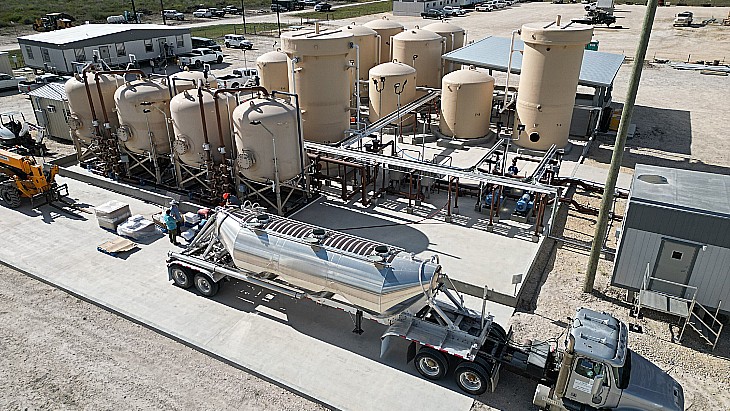
JD-8 is part of the company’s West Slope project in southwestern Colorado. Credit: Anfield Energy
Anfield Energy said on Wednesday it has applied for state approval to restart its past-producing JD-8 uranium and vanadium mine in Colorado, positioning the company to restart production in the second half of 2026.
.......................
[Nucléaire] Relance du nucléaire aux USA.... ou pas ?
Modérateurs : Rod, Modérateurs
-
energy_isere

- Modérateur

- Messages : 104461
- Inscription : 24 avr. 2005, 21:26
- Localisation : Les JO de 68, c'était la
- Contact :
Re: [Nucléaire] Relance du nucléaire aux USA.... ou pas ?
-
energy_isere
- Modérateur
- Messages : 104461
- Inscription : 24 avr. 2005, 21:26
- Localisation : Les JO de 68, c'était la
- Contact :
Re: [Nucléaire] Relance du nucléaire aux USA.... ou pas ?
https://www.world-nuclear-news.org/arti ... al-fundingTwo SMR projects selected for US federal funding
Wednesday, 3 December 2025
The US Department of Energy has selected Tennessee Valley Authority and Holtec to each receive USD400 million in federal cost-shared funding to support early deployments of advanced light-water small modular reactors in the USA.
..................
-
energy_isere
- Modérateur
- Messages : 104461
- Inscription : 24 avr. 2005, 21:26
- Localisation : Les JO de 68, c'était la
- Contact :
Re: [Nucléaire] Relance du nucléaire aux USA.... ou pas ?
Duke Energy soumet une demande de permis préliminaire pour un projet de centrale nucléaire en Caroline du Nord :
https://www.world-nuclear-news.org/arti ... ar-projectDuke Energy submits early site permit application for nuclear project
Friday, 2 January 2026
Duke Energy has submitted a technology-neutral application to the US nuclear regulator for an early site permit for potential small modular reactors at a site near the Belews Creek Steam Station in North Carolina.
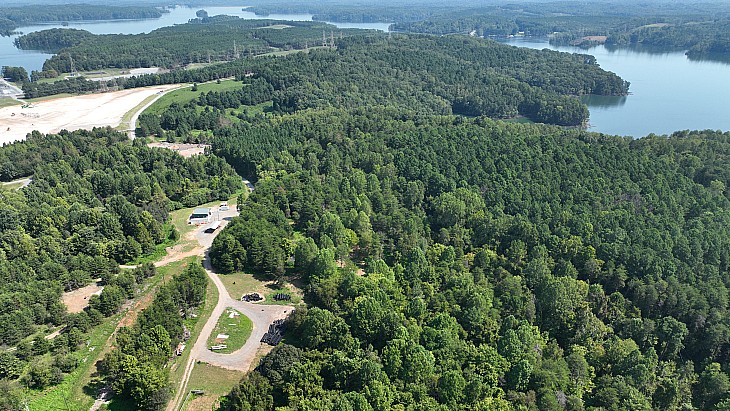
The proposed site at Belews Creek (Image: Duke Energy)
An early site permit - or ESP - is an optional process to confirm a site's suitability for new nuclear generation: possession of such a permit reduces the risk of delays during licensing and construction. The early site permit is technology neutral - a technology can be selected later in the development process - but Duke said its application includes six potential reactor technologies, including four small modular reactor (SMR) designs and two non-light-water designs. Large light-water reactors are not included in the permit application.
"We're taking a strategic approach to new nuclear development that allows us to advance licensing activities while reducing risks and allowing technologies to mature," said Duke Energy's Chief Nuclear Officer Kelvin Henderson.
An early site permit will provide "future optionality" for Duke's customers and the communities it serves, the company said, adding that - if additional evaluation confirms small modular reactor technology at the Belews Creek site offers the best value for customers - it plans to add 600 megawatts of advanced nuclear to the system by 2037, with the first reactor coming on line in 2036. An early site permit is valid for 10 to 20 years, and can be renewed for an additional 10 to 20 years, but would not allow the construction of a plant to begin - that would require a construction permit, or a combined construction and operation licence.
Submission of the application to the US Nuclear Regulatory Commission (NRC) marks the culmination of two years of work, Duke Energy said.
The NRC notified Duke in a letter dated 18 December that it had completed a pre-application readiness assessment of the draft site safety analysis report, environmental report and other supporting documents for the application.
In October, Duke Energy filed a resource plan with utility regulators proposing the evaluation of large light-water reactor technology, as well as small SMRs, to help meet growing electricity demand across North Carolina and South Carolina. The plan identifies the William States Lee III Nuclear Station site in Cherokee County, South Carolina, and the Shearon Harris Nuclear Plant site in Wake County, North Carolina, as those best suited for new large reactors.
The existing Belews Creek Steam Station is a two-unit plant on the shores of Belew Lake, in Stokes County, with a total capacity of 2200 MWe. It was built as a coal-fired plant, entering commercial operation in 1974, but is now co-fired on coal and natural gas (co-firing means the units can use either coal or natural gas, or a combination of these fuels). The current units are scheduled to retire in the late 2030s. Repurposing the site offers a cost-saving opportunity for customers, and enables Duke Energy to reinvest in the local community, the company has said.
Share on socials
Share on Facebook
Share on X
-
energy_isere
- Modérateur
- Messages : 104461
- Inscription : 24 avr. 2005, 21:26
- Localisation : Les JO de 68, c'était la
- Contact :
Re: [Nucléaire] Relance du nucléaire aux USA.... ou pas ?
https://www.mining.com/web/us-awards-2- ... nrichment/US awards $2.7 billion worth of orders to boost uranium enrichment
Reuters | January 5, 2026
The US Energy Department announced on Monday it was awarding orders totaling $2.7 billion to three companies to boost domestic uranium enrichment over the next 10 years in a broader effort to reduce US dependence on Russian supply.
American Centrifuge Operating, General Matter and Orano Federal Services secured the orders, the department said in a statement.
The contracts would require the companies to meet specific milestones to provide enrichment services for low-enriched uranium and high-assay low-enriched uranium, or HALEU, for existing nuclear power plants and new, smaller modular reactors.
“Today’s awards show that this Administration is committed to restoring a secure domestic nuclear fuel supply chain capable of producing the nuclear fuels needed to power the reactors of today and the advanced reactors of tomorrow,” Secretary of Energy Chris Wright said.
Russia is currently the only country that makes HALEU – uranium enriched to between 5% and 20%, which is said to make new high-tech reactors more efficient – in commercial volumes. Funds to make the fuel domestically in the United States were included in a law to ban uranium shipments from Russia fully by 2028.
The DOE awarded American Centrifuge Operating, a subsidiary of Centrus Energy, and General Matter, backed by tech billionaire Peter Thiel, with $900 million each to develop domestic HALEU enrichment capacity. It awarded Orano Federal Services with $900 million to expand domestic low-enrichment uranium production.
The Energy Department separately awarded an additional $28 million to Global Laser Enrichment, part-owned by Canadian uranium company Cameco, to further its work to build next-generation uranium enrichment technology for the nuclear fuel cycle.
Global Laser Enrichment had sought a $900 million award.
HALEU’s critics say it is a weapons risk if it gets into the wrong hands and recommend limiting enrichment to between 10% and 12% for safety. Uranium fuel used in today’s reactors is enriched to about 5%.
-
energy_isere
- Modérateur
- Messages : 104461
- Inscription : 24 avr. 2005, 21:26
- Localisation : Les JO de 68, c'était la
- Contact :
Re: [Nucléaire] Relance du nucléaire aux USA.... ou pas ?
suite de ce post du 6 janvier 2026 : http://www.oleocene.org/phpBB3/viewtopi ... 0#p2420280
https://www.mining.com/web/orano-may-se ... ant-in-us/Orano may seek investors for $5 billion nuclear fuel plant in US
Bloomberg News | January 9, 2026
French nuclear fuel producer Orano SA said it may seek minority investors to help finance a $5 billion uranium enrichment plant that’s planned in Tennessee.
Orano was awarded $900 million this week by the US government to build the facility, but it’s still studying options for the rest of the funding required, the company said Tuesday. That may include equity and debt, as well as potential minority partners.
The Trump administration awarded funds to three nuclear fuel makers as part of an effort to restart domestic production and wean the US off Russian supplies. The move comes amid surging power demand from data centers and mounting pressure on politicians to tame rising energy bills.
State-controlled Orano, which already supplies enriched uranium to US utilities from a plant in France, aims to reach a final investment decision on its US project next year, pending regulatory approvals. Production in Oak Ridge, Tennessee, would start in 2031.
-
energy_isere
- Modérateur
- Messages : 104461
- Inscription : 24 avr. 2005, 21:26
- Localisation : Les JO de 68, c'était la
- Contact :
Re: [Nucléaire] Relance du nucléaire aux USA.... ou pas ?
Nouvelle usine de fabrication de centrifugeuses aux USA :
https://www.world-nuclear-news.org/arti ... velopmentsOak Ridge at heart of US enrichment supply chain developments
26 January 2026
BWX Technologies and Centrus Energy have marked major milestones as they build up their centrifuge manufacturing capacity in Tennessee, with BWXT opening a new facility and Centrus announcing major expansion plans, while laser enrichment technology LIS Technologies is also investing in Oak Ridge.
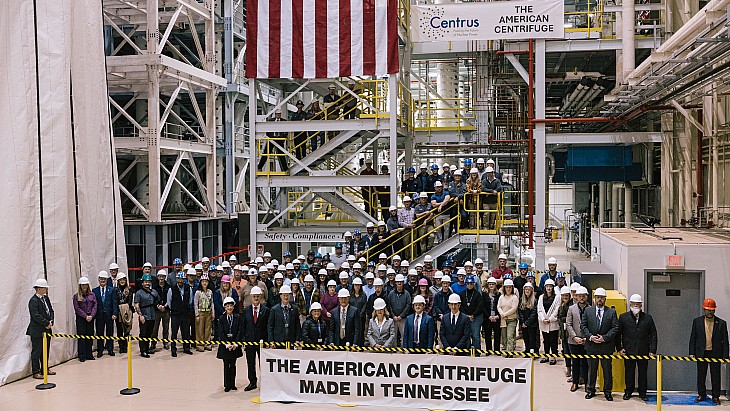
(image: Centrus)
Centrus's plans for a major expansion of its facility at Oak Ridge to a "high-rate manufacturing plant" were announced by Tennessee Governor Bill Lee, Deputy Governor Stuart McWhorter and Centrus Energy President and CEO Amir Vexler. The expansion will see the creation of nearly 430 new jobs as Centrus invests more than USD560 million over "several years" to support both the growth in workforce and investment in the production of thousands of advanced centrifuges.
The company announced in December that it had started manufacturing centrifuges at Oak Ridge - relying on a domestic manufacturing supply chain - to support its commercial low-enriched uranium enrichment activities at Piketon, Ohio, where it plans a major expansion of its uranium enrichment plant to help the company meet America’s commercial and national security requirements.
The company was recently awarded funding from the US Department of Energy (DOE) to expand its uranium enrichment plant in Ohio with centrifuges produced in Tennessee. It has also utilised funding from Tennessee’s USD70 million Nuclear Energy Fund, which is administered through the Tennessee Department of Economic and Community Development.
"These advanced centrifuges are essential to meeting America's energy security and national security requirements," Vexler said. "We are honoured to be a part of the vibrant ecosystem of nuclear energy leaders in East Tennessee and grateful for the strong support of federal, state and local leaders here."
............................
-
energy_isere
- Modérateur
- Messages : 104461
- Inscription : 24 avr. 2005, 21:26
- Localisation : Les JO de 68, c'était la
- Contact :
Re: [Nucléaire] Relance du nucléaire aux USA.... ou pas ?
https://www.mining.com/myriad-uranium-d ... g-project/Myriad Uranium doubles size of Wyoming project
Staff Writer | March 11, 2026
Myriad Uranium says it has effectively doubled the size of its flagship project in Wyoming after geophysical survey results indicated potential in other parts of the property that it has yet staked.
The project, known as Copper Mountain, has now been expanded from 9,439 acres to 18,351 acres to cover all key areas and targets across the district, Myriad said in a press release on Tuesday.
The company staked these additional claims after recent geophysical surveys at Copper Mountain led to the identification of uranium anomalies in previously untested grounds, mostly towards the eastern parts of the property.
To determine which areas to acquire, Myriad said it integrated the new geophysical data with its existing geological dataset, including insights derived from studies completed by Bendix Field Engineering for the US Department of Energy in 1982.
The Bendix study estimated uranium endowments at Copper Mountain of approximately 655 million lb. in uranium oxide equivalent (eU₃O₈) to a depth of 600 feet within a broader “assessment area,” and 245 million lb. eU₃O₈ at the same depth within a more focused “control area.”
Before the expanded staking, most of Myriad’s claims clustered to the west, which is where this historic uranium resource lies. Following the update, the company now controls approximately 62% of the assessment area and 80% of the control area.
.....................
“Confidence is increasing that we now have one of the largest uranium projects in the United States,” he added.
-
energy_isere
- Modérateur
- Messages : 104461
- Inscription : 24 avr. 2005, 21:26
- Localisation : Les JO de 68, c'était la
- Contact :
Re: [Nucléaire] Relance du nucléaire aux USA.... ou pas ?
suite de ce post du 15 aout 2024 : http://www.oleocene.org/phpBB3/viewtopi ... y#p2396490
https://www.mining.com/uranium-energy-e ... licensing/Uranium Energy expands production capacity, advances refinery licensing
Staff Writer | March 24, 2026
Irigaray central processing plant in Wyoming. Credit; Uranium Energy Corp.
Uranium Energy (NYSE-A: UEC) says it has secured Wyoming state approval for additional header houses at its Christensen Ranch in-situ recovery (ISR) operation as part of a planned expansion.
On Tuesday, the Texas-based uranium producer announced that it has begun operating three additional header houses at wellfield 11. One more head house remains subject to regulatory approval, and three more are under construction in wellfield 12 and 10-extension, it added.
“With this approval, we have started uranium extraction at the new header houses enabling the planned increase in production volume at our Christensen Ranch operations,” Brent Berg, SVP of US operations, said in a press release.
The Christensen Ranch operation began in August 2024 and is currently undergoing a major expansion with three new wellfields to increase production, targeting up to 4 million lb. of annual capacity.
The recovered uranium is processed at the Irigaray plant, which is built to serve as the central hub for the 11 projects that UEC holds in the Powder River Basin area. In February 2025, the plant produced its first drummed uranium concentrate, and is now being upgraded for increased throughput.
Conversion facility licensing
UEC also said it has moved a step closer to building a uranium refining and conversion facility, having received a docket number from the US Nuclear Regulatory Commission to move forward with the application for a licence.
The facility, the location of which has yet to be determined, represents a key step in the development of a vertically integrated US-based uranium supply chain that connects UEC’s mining operations with advanced conversion technology.
According to the company, its facility would be the largest of its kind in the country, with the capacity to produce 10,000 metric tonnes of uranium hexafluoride annually, equal to over half of the US demand.
The formal licence application for the plant is expected to be submitted once engineering and design activities, currently underway with Fluor, are complete and a site has been selected, it said on Tuesday.
Shares of UEC shot up more than 3% to trade above $13 apiece in New York, giving the company a market capitalization of $6.3 billion.

-
energy_isere
- Modérateur
- Messages : 104461
- Inscription : 24 avr. 2005, 21:26
- Localisation : Les JO de 68, c'était la
- Contact :
Re: [Nucléaire] Relance du nucléaire aux USA.... ou pas ?
https://www.world-nuclear-news.org/arti ... n-facilityNew US company plans uranium conversion facility
Monday, 30 March 2026
Newly-launched FluxPoint Energy says it is developing what it expects will be the first new uranium conversion facility in the USA in 70 years.
Headquartered in Houston, Texas and McLean, Virginia, FluxPoint Energy was officially launched last week at the CERAWeek international energy event in Houston, Texas. The company said its mission is to "establish a fully American, vertically integrated nuclear fuel capability - supporting energy independence, enabling advanced reactor deployment, and strengthening national security".
The planned facility will convert uranium oxide (U3O8) into uranium hexafluoride (UF6). Uranium must be converted from U3O8 - the "yellowcake" that is shipped from uranium mines and mills - to gaseous UF6 before it can be enriched in fissile uranium-235 for use in nuclear fuel. FluxPoint Energy is targeting first production in 2030–2031.
The company said that development of the facility "is well under way". The company has already secured a project site and due diligence work is in progress. A comprehensive market study and a technical feasibility study have been completed, while Front-End Engineering Design (FEED) studies have been initiated.
The company said it is actively engaging with federal and state stakeholders on regulatory pathways and reporting strong early interest from prospective customers and investors.
"Policymakers, utilities, and developers increasingly point to fuel availability as a limiting factor for America's nuclear reactors - both present and future," said Mike Chilton, Founder and CEO of FluxPoint Energy. "Uranium conversion has become an unacceptable chokepoint in a global supply chain still dominated by foreign providers.
"America cannot lead in nuclear energy while relying on foreign-controlled fuel processing. FluxPoint was created to restore a critical piece of our nation's energy infrastructure - ensuring that US reactors have access to a secure, domestic fuel supply. This is about energy security, economic strength, and global leadership ... As global demand for reliable, carbon-free energy accelerates, FluxPoint Energy is positioning itself at the centre of a renewed American nuclear supply chain. We are helping unlock nuclear power's full potential as a cornerstone of the nation's energy future."
The initiative responds to federal policy under recent executive orders from the White House calling for a fourfold increase of US nuclear generating capacity by 2050 and reducing reliance on overseas suppliers. Onshoring the nuclear fuel cycle is seen as a priority for national security.
Honeywell's Metropolis Works plant, built in the 1950s in southern Illinois, is currently the only uranium conversion facility in the USA. It was temporarily shut down from 2017 to 2023 due to poor market conditions, but was restarted in July 2023. Solstice Advanced Materials - which was spun off from Honeywell in October last year - has invested in de-bottlenecking projects at Metropolis Works following its 2023 restart with the aim of raising production.
In September 2025, Texas-headquartered Uranium Energy Corp (UEC) launched a new subsidiary - called United States Uranium Refining & Conversion Corp (UR&C) - to pursue the feasibility of developing a new US uranium refining and conversion facility. The proposed facility - which UEC says will be the largest conversion facility in the USA and "amongst the most modern in the Western world" - is envisaged as having a designed capacity to produce some 10,000 tU per year as UF6, representing a "substantial share" of the USA's 18,000 tU per year demand.
-
energy_isere
- Modérateur
- Messages : 104461
- Inscription : 24 avr. 2005, 21:26
- Localisation : Les JO de 68, c'était la
- Contact :
Re: [Nucléaire] Relance du nucléaire aux USA.... ou pas ?
en relation avec ce post du 29 mars 2026 : http://www.oleocene.org/phpBB3/viewtopi ... 3#p2423013
https://www.world-nuclear-news.org/arti ... um-projectProduction begins at US uranium project
Thursday, 9 April 2026
Uranium Energy Corp's Burke Hollow in Texas is the first new in-situ recovery operation to start up in the USA in over a decade.
Burke Hollow (Image: CNW Group/Uranium Energy Corp)
In-situ recovery - or ISR - is a method of mining uranium by dissolving and recovering it via wells. It is also known as in-situ leaching. Ground water fortified with a complexing agent, and often with an oxidant (such as gaseous oxygen), is introduced into the orebody to dissolve the uranium from the sandstone host. The uranium-bearing before being recovered and processed into yellowcake.
Uranium Energy Corp (UEC) has two ISR hub and spoke platforms in South Texas and Wyoming, with a central processing plant as the "hub" with several ISR uranium projects providing "spokes". Production from Burke Hollow will be processed at the company's Hobson Central Processing Plant, which is licensed to produce up to 4 million pounds of uranium per year.
"The startup of Burke Hollow is a significant achievement for UEC, advancing the project from a grassroots discovery in 2012 to production in 2026," UEC President and CEO Amir Adnani said. "With two ISR operations now producing, and our Ludeman ISR project planned for startup in 2027, we are building a scalable, multi-faceted platform supported by the largest uranium resource base in the United States."
According to UEC, Burke Hollow is the largest ISR uranium discovery in the USA in the past decade, with significant long-term development potential: only about half of the property, which covers some 20,000 acres (over 8,000 hectares) has been explored to date. The estimated mineral resource for the project is currently 6,155,000 pounds U3O8 (2,368 tU) in the measured and indicated category, plus 4,883,000 pounds U3O8 of inferred resources.
Production was able to start following the receipt of final approvals from the Texas Commission on Environmental Quality (TCEQ). Craig Wall, UEC's Vice President, Environmental, Health & Safety, Texas said the commission's approval, coming after more than a decade of exploration, permitting and development, "reflects the strength of our technical and operational execution. We appreciate the collaboration and professionalism of the TCEQ throughout the process and look forward to continuing to work with them as the project advances."
UEC's South Texas team will now focus on ramping operations and constructing additional wellfields across the project.
In addition to the largest uranium resource base in the USA, with 12 million pounds per year of uranium production capacity across its Wyoming and South Texas hub-and-spoke ISR operations, UEC also controls extensive land and resource portfolios in Canada's Athabasca Basin, including the Roughrider Project in Saskatchewan. The company is also pursuing domestic refining and conversion capabilities in the USA through its United States Uranium Refining & Conversion Corp subsidiary.